
Supplier Performance on a Fractured Master
OTIF, quality, and SLA scores only work if they attach to one supplier identity. A split master makes the scorecard a reconciliation exercise.

Founder & Chief Executive Officer
- Published
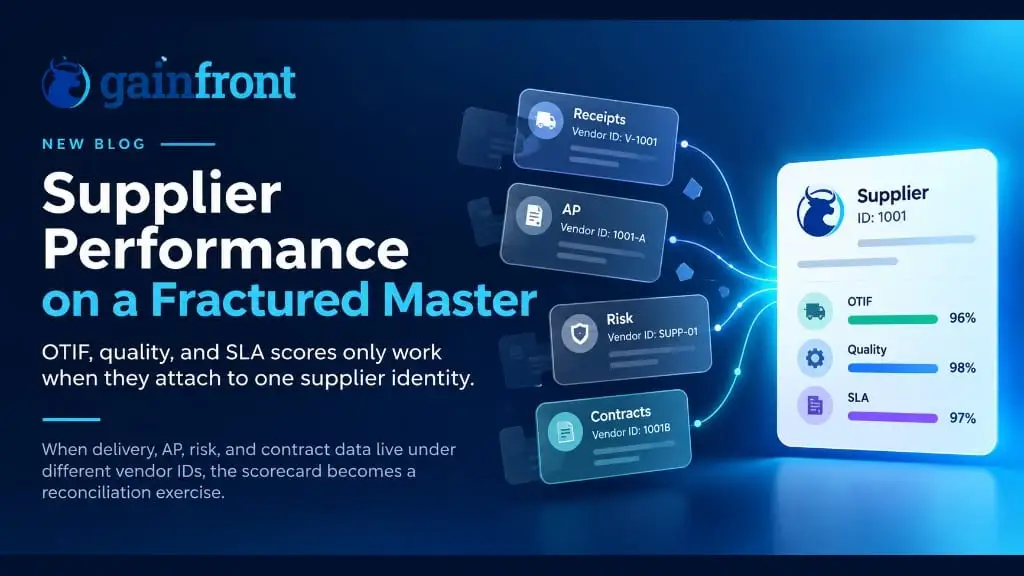
Plant A receipts vendor 10482. Accounts payable pays 10482-B. The risk file watches Acme Industrial LLC. The quarterly pack averages the three and labels the result OTIF.
That figure is not a supplier score. It is three partial stories under one heading. Supplier performance management only works when delivery, quality, and SLA events attach to the identity you already pay. Supplier lifecycle management is the record those events have to share. If they do not, the scorecard is a reconciliation exercise.
Metrics that require a stable identity
A metric survives a fractured vendor master only when every event it counts can be tied to one surviving ID. If the join key is a spelling, the score is an argument about extracts.
| Metric | What it counts | What a split ID does |
|---|---|---|
| OTIF | Orders received on time and in full against the promise | Plant receipts and ERP shipments land on different IDs, so one site looks late and another looks clean |
| Quality | Defects, returns, or non-conformances against units received | Non-conformances sit on the plant file, and the enterprise scorecard never sees them |
| SLA compliance | Contract terms actually met: response windows, fill rate, documents on file | The contract row and the vendor accounts payable pays are not the same ID, so a miss never hits the score |
| Lead-time variance | Gap between promised and actual lead time | Expedites get coded to a one-off vendor, and the supplier you renew looks reliable |
| Cost variance | Invoice price against the contracted price | The price hold lives on the contract, the invoice hits a duplicate, and the leakage never scores |
| Response time | Time to confirm a change or close an issue | The mailbox that answers is not the ID on the scorecard |
Do not average those rows into one grade until they share an ID. A blended OTIF across three spellings is a number nobody can act on. Show the unmatched remainder as a data gap. A blank is more honest than a grade built from one plant.
Scorecard vs QBR vs the record
Three different objects get treated as one meeting.
The record is the identity: legal name, tax ID, ship-to site, and the vendor ID accounts payable will pay. The supplier performance scorecard is the measurement attached to that identity. The QBR is the meeting that uses the scorecard to change the relationship: a lead time, a defect escape, a renewal, a dual source.
When the identity is split, the meeting changes job. Quality brings the plant file. Accounts payable brings the vendor master. Risk brings a third spelling. Procurement spends the hour deciding whose extract is allowed to speak. Nobody changes the relationship.
A scorecard that cannot name one ID is not a management tool. It is the agenda for that argument. The supplier profile is what the events have to hang on. If onboarding opens a new vendor ID instead of matching the one you already pay, the scorecard is fractured on day one. That is the same break the vendor onboarding guide describes at intake.
How to evaluate supplier performance when extracts disagree
When the extracts disagree, evaluation is a match problem. It is not a dashboard problem.
- Name the surviving identity before you open the spreadsheet. Match on tax ID, legal name, and site. Two rows that fail that match are not one score yet.
- Map each extract onto that identity. Receipts, invoices, non-conformances, and SLA tickets keep their source system. They do not get averaged until the map is written down.
- Hold the score when the map fails. Publish the supplier as unscored because the identity is split. Do not fill the cell with the one plant that happened to export on time.
- Score only the events that joined. OTIF, quality, and SLA each sit on the surviving ID. The rows that did not join stay visible as unmatched volume, not as performance.
- Stop the next duplicate at onboarding. A cleanup that does not block a new vendor create refills the scorecard. Next quarter is the same QBR with one more spelling.
The ERP vendor master is the ID accounts payable pays. It rarely holds non-conformances, insurance, or the contract SLA. Performance can read that ID. It should not be trapped inside it. Keep the score on the supplier record the rest of the stack can reuse.
Gainfront keeps delivery, quality, and SLA scores on the same supplier identity as onboarding and risk, so the QBR opens on one record instead of three extracts. Book a demo and walk a split vendor ID through one scorecard.
FAQ
Why does OTIF disagree across plants?
Each plant often receipts against its own vendor ID. Headquarters then averages files that are not the same supplier. The disagreement is an identity mismatch. It is not a formula error in the scorecard.
Can a scorecard run before the vendor master is clean?
Yes, on the suppliers whose IDs already match. Hold the rest. A partial score on a known identity is usable. A full score that blends duplicates is not. Cleaning the master and freezing new duplicates at onboarding is what lets the held rows come back.
What is the difference between a scorecard and a QBR?
The scorecard is the measurement on one supplier identity. The QBR is the conversation that decides what changes because of that measurement. If the room is still reconciling extracts, the QBR has not started.
Which metrics fail first when one supplier has several IDs?
OTIF and quality fail first, because receipts and non-conformances are recorded where the goods arrived, and invoices are recorded where accounts payable created the vendor. Cost variance and SLA compliance fail next, because the contract and the payment ID have drifted apart. Response time fails quietly: the team that answers is not the ID being scored.
Should performance live on the ERP vendor master?
Use the ERP vendor ID as the key accounts payable already pays. Do not make the ERP the only place the score exists. Non-conformances, contract SLAs, and risk flags usually live outside it. Supplier performance management has to read those sources onto the same identity, or the QBR goes back to three spreadsheets.